

A hotel can spend three million baht on a new property management system and, six months later, still be running the business from a spreadsheet.
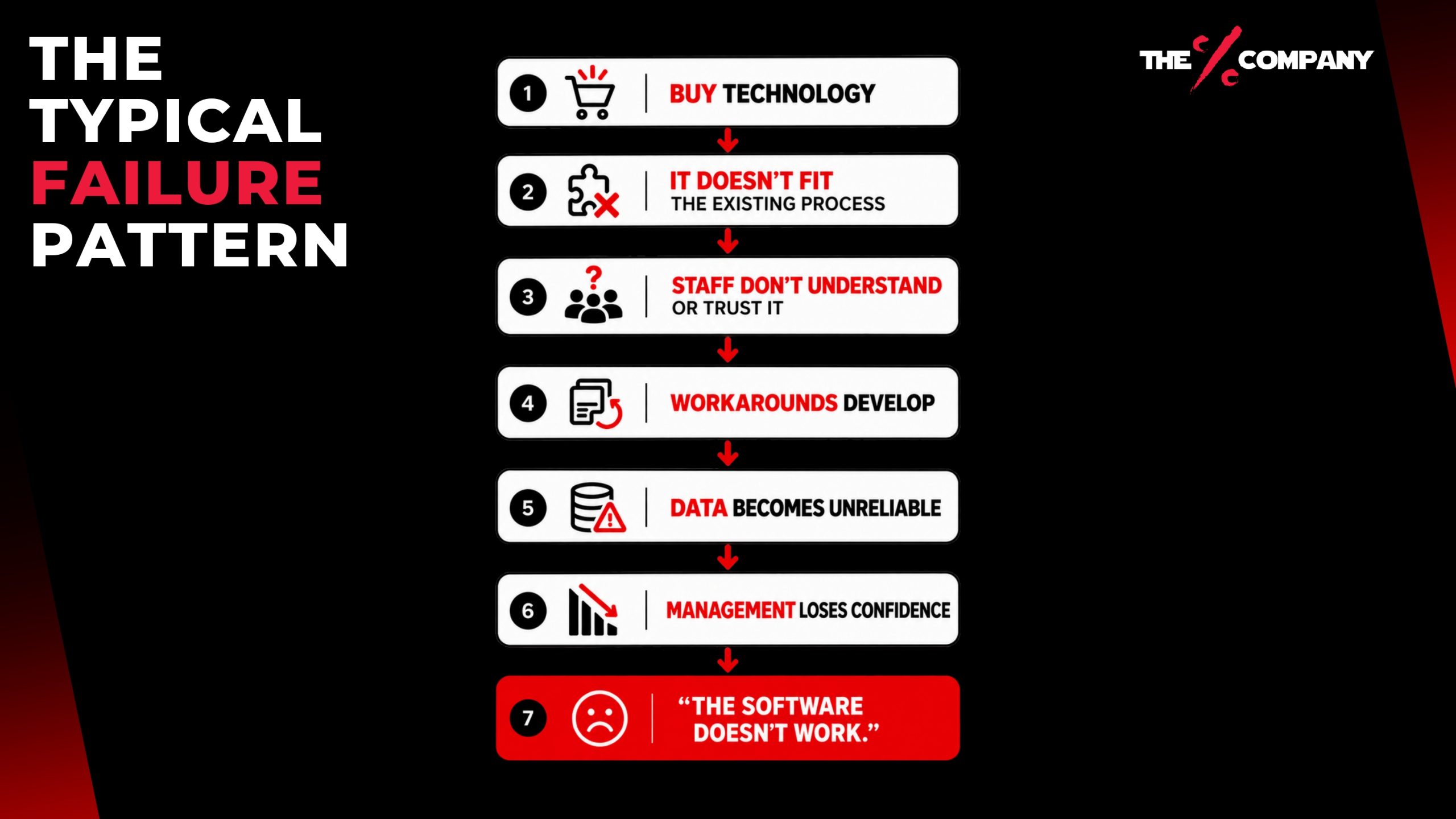
The staff don’t use the new system properly. Managers don’t trust the reports. Information is entered twice, once in the new system and once in the old one that nobody quite dared to switch off. And everyone, from reception to reservations to accounts, has their own private workaround.
Nothing about the software has failed. The project has.
That was the starting point for a guest lecture I gave last Friday at the Faculty of Hospitality and Tourism, Prince of Songkla University, Phuket Campus. The subject was Why Hospitality Technology Projects Fail, and whilst the audience was a room full of students preparing to enter the industry, the message is one I’d put in front of every hotel owner, general manager and attraction operator considering a new system, a digital transformation programme or, increasingly, an AI project.
Back in the Classroom at PSU Phuket
This was my third session with the students, and I’m grateful to Asst. Prof. Dr. Kevin Fuchs for inviting me back once again. Previous sessions have covered design thinking in hospitality web design and digital guest experiences. This time we looked at the relationship between people, processes and technology, and why successful digital transformation is about much more than simply installing new software.
What I particularly enjoy about these sessions is the quality of the questions. The students are entering an industry that’s changing rapidly, and it’s encouraging to see them thinking well beyond traditional hospitality roles: towards revenue management, e-commerce, CRM, data and hospitality technology itself.
My next session is at the end of November, on Revenue Management as Process Innovation, looking at how hotel pricing has evolved from static seasonal rates into a continuous, data-driven process involving forecasting, inventory management, distribution and dynamic pricing.
But the lecture on why projects fail is worth sharing more widely, because the lessons apply far beyond the lecture theatre. If you run a hotel, a resort, a show or an attraction, and you’re thinking about a new system or an AI implementation, this is written for you.
The Most Dangerous Sentences in Hotel Technology
I asked the students to imagine the failed three million baht project above and choose the most likely cause. Was it bad software? A bad vendor? Poor training? A system that didn’t fit the hotel’s process? Or management failing to manage the change?
The honest answer is that it’s rarely the first two. Over the past twenty years working in hospitality technology, I’ve seen the same pattern repeat itself across hotels of every size. The software is usually capable. What goes wrong sits around it.
You can spot a struggling project by listening to how people talk about it:
“We have a workaround.”
“We keep it in Excel.”
“Just send it to me on LINE.”
“Reception knows how to do it.”
“Don’t use that report.”
“Only one person knows how this works.”
“We still keep the old system, just in case.”
Every one of these sentences is a symptom. Each one tells you that the technology and the way the business actually operates have drifted apart, and that people have quietly filled the gap themselves. Workarounds feel harmless, even resourceful, but they’re where data goes missing, where errors creep in, and where the return on your investment slowly leaks away.
Technology Doesn’t Fix a Broken Process
This is the point I most wanted the students to take away, and it’s the one I’d most like hotel owners to hear.
Technology doesn’t fix a broken process. It makes it faster, bigger, more automated and more expensive, but still broken.
If your reservations team handles group enquiries in five different ways depending on who picks up the phone, a new system won’t standardise that. It’ll simply record five different versions of the truth. If nobody owns rate decisions, a revenue management tool won’t create ownership. It’ll produce recommendations that nobody acts on.
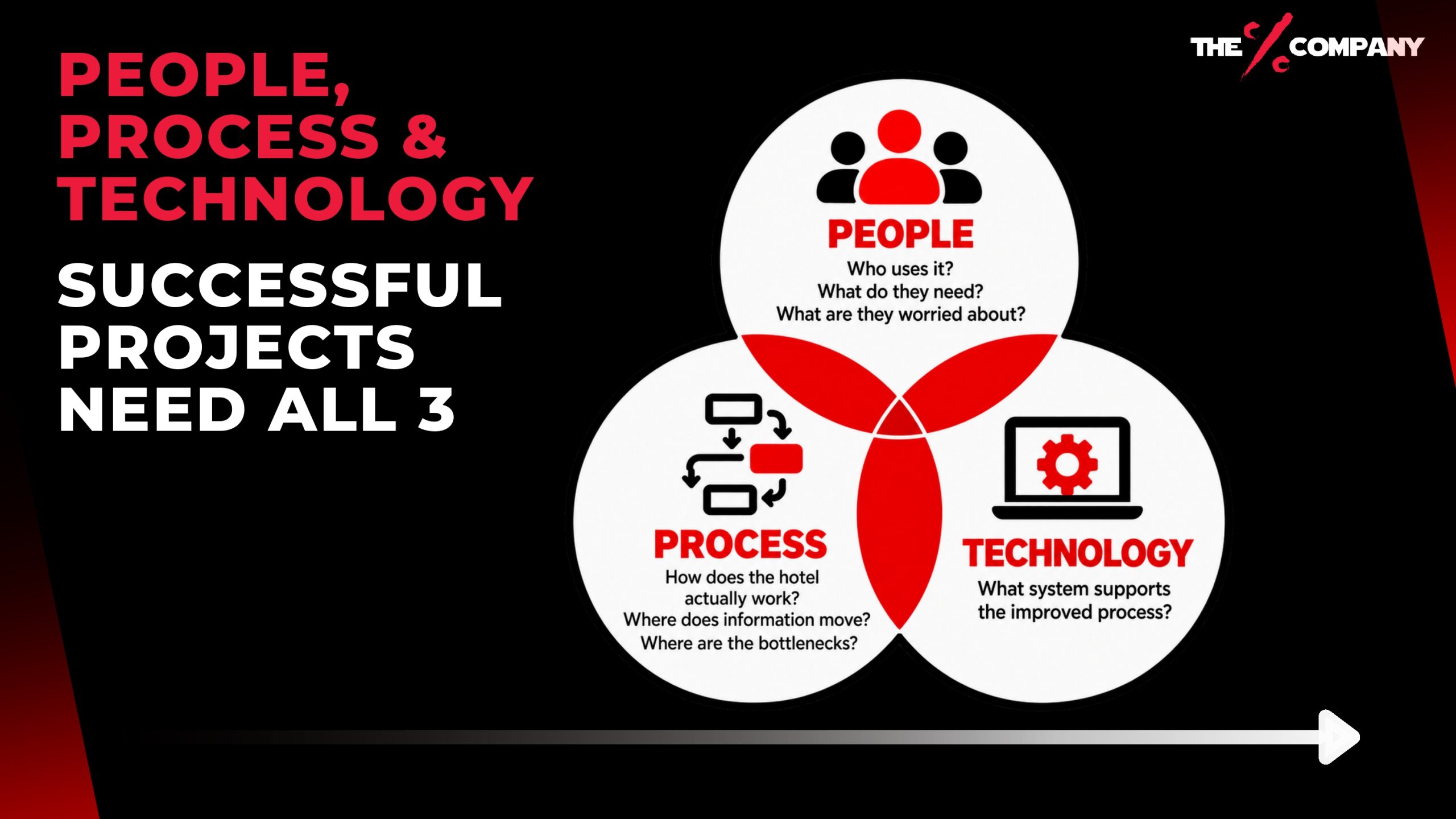
Successful projects need three things working together: people, process and technology. Most projects put almost all of their attention on the third and assume the first two will sort themselves out. They rarely do.
Start With the Problem, Not the System
Most technology projects begin with the wrong question: “Which system should we buy?”
It’s an understandable question. Vendors are easy to find, demonstrations are persuasive, and buying something feels like progress. But it skips every step that determines whether the purchase will succeed.
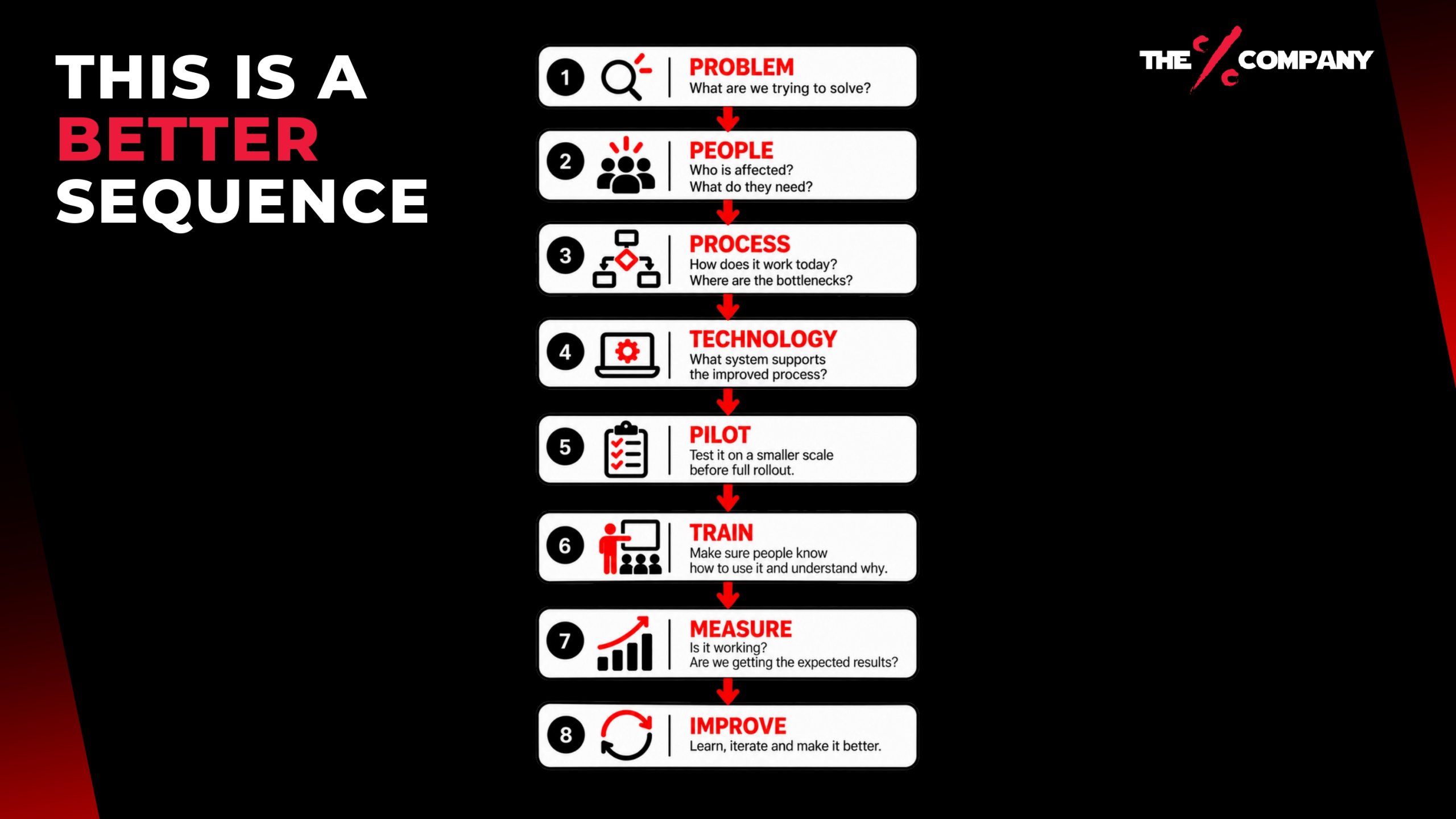
Better questions come first:
What problem are we actually trying to solve?
Who experiences that problem, guests, staff or management?
How does the business work today, in practice rather than on paper?
What should the process look like?
What technology can support that process?
Only once those are answered does the choice of system become meaningful. Occasionally, the answers reveal something uncomfortable but valuable: the problem isn’t technology at all. It’s a process, a missing responsibility or a training gap that no software would have fixed.
Sometimes the answer isn’t new technology.
A partner who tells you that is worth far more than one who sells you something regardless.
People Don’t Resist Technology, They Resist More Work
Hotel teams are often described as resistant to change. In my experience, that’s rarely fair. People don’t resist technology. They resist change that creates more work, more uncertainty, less control, less confidence or unclear benefits.
I gave the students a simple test. Imagine you’re a receptionist. The old system takes two clicks to complete a task. The new system takes six. Management tells you the new system is much better.
Which one will you prefer at eleven o’clock at night with a queue of guests at the desk?
That’s not resistance. It’s a perfectly rational response to a system that has made someone’s job harder. If the people using a system every day can’t see what it does for them, they’ll find a way around it, and you’re back to the workarounds.
It’s also why training on its own isn’t enough. Training is not adoption. A team can sit through every session, pass every exercise, and still go back to the old way the following week. Adoption happens when the new way is genuinely easier, when people were involved in shaping it, and when someone is still there after go-live to answer questions and fix the small irritations before they become habits.
The Same Rules Apply to Ticketing, Shows and Attractions
None of this is unique to hotels. If anything, the stakes are higher in ticketing.
A show or attraction moving to a new ticketing or venue management system has the same human and process challenges, with less room for error. There’s a fixed performance time, a seating plan, ticket agents and tour operators who need their allocations, and gate staff who need entry to work smoothly the moment the doors open. A ticketing project that hasn’t mapped how agents book, how payments reconcile, how seat inventory is controlled and how guests are actually admitted will surface every one of those gaps on opening night, in front of customers.
The principle is identical. Understand how the operation really works, design the process properly, bring the team with you, and then configure the technology to support it. Not the other way around.
Don’t Start With AI
The question I’m asked most often by hotel owners and attraction operators right now is some version of: “What should we be doing with AI?”
I understand the urgency. AI is changing guest communication, search, pricing and marketing, and nobody wants to be left behind. At The Percentage Company we build and deploy AI in hospitality every day, so I’m certainly not arguing against it.
But AI follows exactly the same rules as every system before it, only more so. An AI assistant answering guest enquiries is only as good as the information, rates and availability it’s connected to. An automated pricing recommendation is only useful if someone owns the pricing decision and the underlying data is clean. Automating a process that’s poorly understood simply produces poor outcomes at greater speed and scale.
AI is a tool, not a strategy. The strategy is solving the business problem.
So when a hotel asks us about AI, the first conversation isn’t about which model or which product. It’s about where the business is losing time, revenue or guests today, and whether AI is genuinely the right answer to that. Often it is. Sometimes something simpler would serve better. Either way, starting with the problem is what makes the AI investment pay back.
Measure Business Results, Not Go-Live Dates
Many technology projects are declared a success on the day the system goes live. The vendor sends a congratulations email, the project is closed, and everybody moves on.
But go-live isn’t the outcome. It’s the starting line. The real measure of success is what changes in the business afterwards: more direct bookings, fewer manual hours, faster check-in, more accurate reporting, better rate decisions, fewer errors, a better guest experience, more revenue.
If a project can’t be measured against results like these, it’s very difficult to know whether it worked. And if nobody is looking at those results after launch, the workarounds have a habit of quietly returning.
Why We Take the Thorough Route
This is why we approach implementation the way we do at The Percentage Company, whether we’re working with a single boutique hotel, a multi-property group or a large show or attraction.
We start by understanding how the operation really works before recommending anything. That means talking to the people who do the work, not just the people who sign off the budget, and mapping the processes the technology will need to support. Where something is broken, we’d rather say so at the beginning than build on top of it.
We design with the team, so the system makes their working day easier rather than harder. We phase implementation where it reduces risk, and we stay involved after go-live, because that’s when the real adoption work happens. And we measure success in business terms, which is a natural fit for us: most of our work is on a commission basis, so our results are tied directly to our clients’ results.
It isn’t always the fastest route to a launch date. It is, in my experience, the most reliable route to a project that’s still delivering value two or three years later. Across more than 700 clients worldwide, the projects that succeed are almost always the ones where the groundwork was done properly.
A Technology Project Is Really a People and Process Project
If I had to reduce the lecture to a single idea, it would be this: a technology project is a people and process project that happens to involve software.
The next time someone in your business says “we need a new system”, resist the urge to immediately ask “which system?” Ask why. Ask what problem you’re actually trying to solve. The answer to that question will do more for the success of your project than any feature list.
At The Percentage Company, we believe hospitality technology, and AI in particular, deserves that kind of thoughtful, grounded approach. Our work sits at the intersection of hotel operations, revenue management, ticketing and software, designed specifically for independent hotels, resorts and attractions in Thailand and beyond. If you’re considering a new system, a digital transformation or an AI implementation and would like a second opinion before you commit, we’d be happy to have a conversation.
Written By: Edward Kennedy
Co-Founder & Director at The Percentage Company. I started working on websites in 1997 and have been a full-time techie since 2001. I’m committed to leveraging the latest technologies and digital marketing techniques to drive efficiency & improve online sales for our hotel clients. I have a 20+ year track record of success in growing independent hospitality & real estate brands.